
5 Step Guide for Teaching Your Newborn Great Sleep Habits

Are you ready for the secret sauce to newborn and infant sleep?
If we had to guess, you might even be ready to buy it in a Costco size bottle of it. Well, guess what?! Your first bottle is ON US!
Let’s get a couple of things out of the way before we dive in. First off, this post is a BEAST! If you are a sleep-deprived parent, then you might feel overwhelmed with all of the info we are giving out. The good news is we divided it up into 5 steps- just for you! This is your one-stop shop + tangible tips on ALL THE THINGS when it comes to babies and sleep. Bonus- it’s designed to start during your baby’s first couple of days at home!
Here at IBP, we are professional baby whisperers who can help you right now. So here we go!
WILL I EVER SLEEP AGAIN?
The age-old question…Will I ever sleep again? Yes, you will, we promise. But let’s face the facts- once you become a parent, sleep is never quite the same. You go from around-the-clock feedings to sleep regressions to teething, to big kid bed transitions to littles that just seem to magically appear in your bed in the middle of the night. Once you’re past all of that, you’ll have teenagers, which naturally leaves you sleeping a little lighter and staying up at all hours waiting for them to return safely home. You then have to multiply this process by however many children you choose to have. Sounds daunting, right? Thankfully, humans are adaptable! And you don’t have to just survive the process- it is possible to thrive.
step 1: know the guidelines for safe sleep
Here’s the deal. There are so many opinions and pieces of information about infant sleep- what is normal, what is appropriate, and what is safe. Over here, we are always going to follow and teach on AAP sleep recommendations*.
BACK TO SLEEP FOR ALL SLEEP TIMES (NAPS AND OVERNIGHT) UNTIL A YEAR OLD. Skin-to-skin time is always appropriate and encouraged so long as the parent is awake during this time. Once the infant is rolling forward and backward on their own, it is appropriate to leave them in the position they choose- but it is suggested that you lay them on their back first and allow them to get into the position they are most comfortable in.
FIRM, FLAT SURFACE WITH TIGHTLY FITTED SHEETS. We promise with a good swaddle and some other sleep cues, you can get your baby to rest soundly in a crib or bassinet without using a positioner. When shopping for these items, it is necessary for the term “crib” or “bassinet” to be in the title of the product- this lets you know that it was tested and meets the criteria for the Consumer Product Safety Commission.
KEEP THE FRILLS AT BAY. Keep soft objects, positioners, loose bedding, bumpers, blankets, toys, or any other objects out of your baby’s sleep space. If you are anything like us, you love a cozy bed with the softest sheets, a welcoming pillow, and fuzzy blankets. The idea of having your baby sleep in a sparse space can make you feel guilty. It’s ok to feel that way and still choose safe sleep. Thankfully, a baby doesn’t need all the frills! Your baby should be sleeping in a completely bare space until approximately a year old. All you need is a really good swaddle technique until your baby is trying to roll, and then switch to a wearable blanket/sleep sack. This will make them feel safe and secure while mimicking the snugness of the womb- all while sleeping safely in their bassinet or crib.
BED-SHARING IS NOT RECOMMENDED. Let’s preface this by saying that sleep is a necessity for our well-being, our physical health, and our mental health. At the end of the day (or middle of the night), there might be occasions where this happens, whether by accident, out of complete necessity for getting some sleep, or purely by choice as a parent. You can read all of the recommendations and guidelines, but you’re still the parent, and we ALL do the best we can. If it helps, both of us have dozed off with our own babies during those exhausting, fresh postpartum days. Does that make us bad moms? NO. Parents are tired in every single way.
Here are our simple tips if you are actively avoiding bed-sharing:
During night feedings, set an alarm if you feel like you might fall asleep during the feeding.
The risk of suffocation is much higher in a chair than in your bed, so feed sitting up in bed.
Enlist your partner’s support in helping you stay awake.
Make your bed a safer sleep space by eliminating extra pillows and blankets- make sure your fitted sheets are snug.
Don’t bring your baby into bed with you if you have been using alcohol, prescription narcotics, medication that makes you drowsy or dizzy, or recreational substances in any form.
Hire overnight postpartum doula support
ROOM SHARE WITH YOUR BABY. Every parent will have a different answer for when they transition their baby into their own room and crib. Again, we ALL do the best we can and make parenting decisions based on our specific circumstances. However, the guidelines recommend room sharing (not to be confused with bed sharing) for at least the first 6 months, and up to a year. The main reason for this (among many) is that newborns have a unique capability of matching breathing and heart rate rhythms to yours when they are close to you in their own safe crib or bassinet.
USE A PACIFIER. Using a pacifier has been noted to have the potential to help prevent SIDS. We also use it as a tool to help with sleeping. This doesn’t mean that every baby will like it, and you can also choose to get rid of it before a sentimental attachment forms.
All sleep safety guidelines were made in an effort to prevent SIDS- Sudden Infant Death Syndrome and other sleep-related deaths. We aim to keep all babies as safe as possible and would love the opportunity to help you navigate these guidelines.
“What Products do you recommend for sleep?”
We get this question all of the time! Click on the link below for our go-to products.
Our Favorites
step 2: start a sleep routine right away
Let’s face it- the first couple of days/weeks home are a whirlwind, so we suggest starting to use sleep cues the minute you get your bearings. Sleep cues are intentional steps YOU take routinely to signal to your baby that it’s time to sleep. The ideas below are some of the standard cues we use as postpartum doulas, and you’ll notice that they hit on each of the 5 senses (touch, sight, sound, smell, taste). We suggest using the same routine for naps that you would for bedtime- only adding the extra steps you choose for bedtime.
NAPTIME ROUTINE:
A dark room- hello blackout curtains!
Swaddling
Sound machine
Using the 5 S’s to calm and help baby fall asleep
Using gentle + comfortable pressure on baby as they drift off
BEDTIME ROUTINE:
All of the above, along with adding one or more of the following-
Bath time or favorite lotion/massage at bedtime
Rocking
Singing or stories
step 3: know the 5 S’s and how to use them
The 5 S’s are probably one of the most valuable tools we use as postpartum doulas. It’s based on the book, The Happiest Baby on the Block.
THE MAGICAL 5 S’s
1. Swaddle
2. Stomach or Side-Lying (postion for baby while holding them- your postion is standing or sitting)
3. Shush
4. Swing/Sway (or we like to squat too)
5. Suck
We like to use all 5 of these techniques simultaneously to help babies fall asleep. Once they begin to steadily drift off, we transfer them to their crib or bassinet while maintaining gentle pressure with our hands around their body to mimic the womb until the baby is in sounder sleep. It takes about 10 minutes for a baby to get into a deep sleep once they are placed in their sleep space. You will begin to notice when they relax into that deeper sleep, and it’s at that time you can gradually relieve pressure.
step 4: recognize when your baby is giving sleepy cues
While you are busy creating sleep cues for your baby- 5 S’s, dark room, swaddle, sound machine, routines- don’t forget to watch for cues your baby is giving you! They are smart little people with a lot to say without ever speaking a word. Out of all of the steps, this one can be a game-changer in the long run.
Babies, even tiny newborns, will communicate when they are tired. Most people think it’s when baby yawns or starts to fuss…when in reality, they were giving off signs that they are ready for sleep long before then. Here’s what to look and listen for:
EARLY SLEEPY CUES- The Sweet Spot!
Jerky movements- limbs and head
Gazing
Red rims- skin around eyelids turning red/pink
REALLY SLEEPY CUES- About to BlowSqueaky or grunting sounds
Pulling/grabbing their face
Yawning
LATE SLEEPY CUES- Full on MeltdownArching back
Crying
Rigid
Hard to console
Now, some of these signals can mean hunger. If you know your baby is full and they are nearing the end of their wake time window, then they are telling you it’s time for sleep.
Soon after you welcome your new little one, you will begin to hear and see their sleepy cues...in the same manner you hear and see their feeding cues. And just like you don’t want to wait to feed a screaming baby, you also don’t want to wait until baby is screaming to begin their routine. Start your sleep routine with your baby as soon as they begin early sleepy cues, as they are nearing the end of their wake time window.
step 5: learn age appropriate wake times
Here’s the deal- the best (or the worst) sleep habits begin during the day. GASP! It’s true!
We always like to say that sleep begets sleep. In other words, the better your baby naps during the day, the better your baby will sleep at night. The great news is that it’s much easier as parents to teach a baby to sleep during the day when you are more alert than at night when you are groggy and desperate for sleep at 2am...ya know, when your baby is up once again!
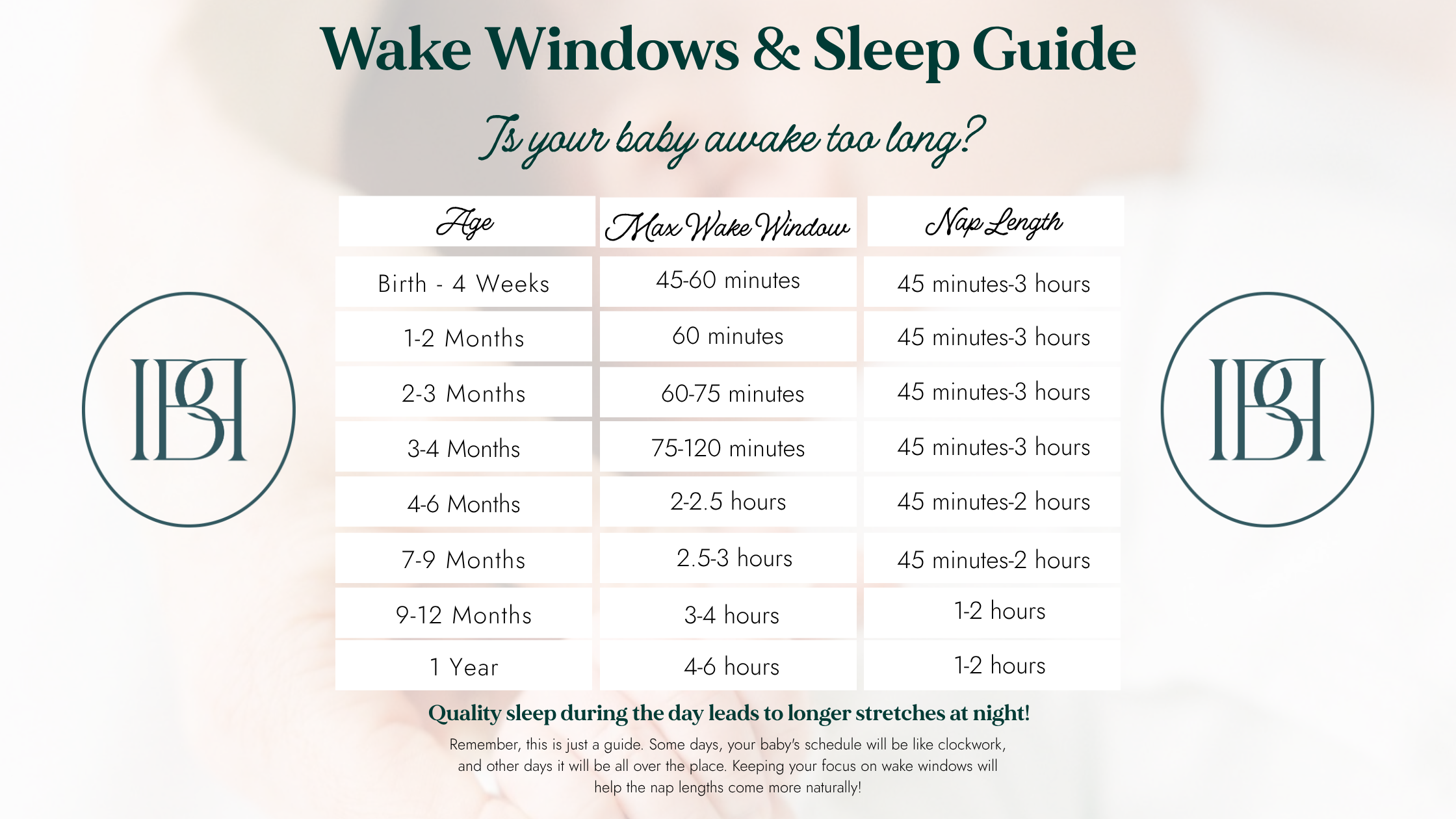
Because of this, we ALWAYS suggest starting the sleep learning process during the day. How do you do this? You use our very handy sleep chart- and not in the way you might expect. Oftentimes, parents see this and think that this is the amount of time they need to keep their baby AWAKE. Instead, look at it from a different angle. We want you to look at it and say “Oh, my baby has been up for (x) amount of time, so it’s time to get them ready for their nap.” This small change of perspective makes a significant difference with tired parents!
The times on the chart are MAX times. Once you get into a little bit of a groove with this practice, you’ll notice that if your baby isn’t already asleep, your baby’s sleepy signals will start to happen right around or before when that max wake time hits.
Awake time starts the moment they wake up from one sleep session and lasts all the way until they are snugly placed back into their sleep space for the next sleep session. This includes the time it takes for nursing or bottle-feeding, even if their eyes are closed. So if baby’s nap routine takes about 15 minutes to go through, your goal is to start the routine about 15 minutes before their max wake time. It is also appropriate to start the routine earlier if you’re noticing that your baby is showing you that they are tired via their sleepy signals.
There are only a few times that we suggest capping naps-
If your baby hasn’t met their birth weight or if they are underweight and need to eat more frequently.
If the wake time following the nap will cut into their bedtime routine.
We don’t suggest specific nap times until your baby is several months old. Once you get into a routine with wake times your baby will gradually and naturally fall into specific nap times. It’s always okay to start a bedtime though! We usually suggest 7pm to 7am or 8pm to 8am or somewhere in between right from the start.
PLEASE NOTE- The first nap of the day is going to be a continuation of nighttime sleep, so it will be on the shorter end of the max wake time. It may also be the most quality nap of the day. This is the perfect time for parents to get more sleep themselves after a long night. As the day goes on, baby will naturally be able to stay awake and alert a little longer. Naps typically become a little shorter, and you will hit the tail end of that max wake time later in the afternoon/evening.
OUR GAME-CHANGER NAP TIP
READY FOR IT?!?! Baby sleeps in their same sleeping space for daytime AND overnight! Many parents think that saving the crib or bassinet for only nighttime signals to their baby that it’s time for the “good sleep.” When, in reality, all sleep- daytime naps and nighttime sleep- should try to happen in the same place regardless of the time on the clock.
Now, we get life happens, and you won’t always be at home when baby needs a nap, so don’t stress about those circumstances. And some contact naps during the day can be beneficial for parents and baby. You need to live! Simply make it your goal to have baby in their designated sleep space whenever you are home, as often as possible.
are you tired yet?
We know, we know…this is an abundance of baby sleep tips and information. With our overnight postpartum clients, we lead by example- teaching through hands-on care in real time. For exhausted parents navigating it alone, we hope this serves as a helpful starting point for shaping healthy sleep habits.
FINAL THOUGHTS
This isn’t a promise that following these steps will have your newborn sleeping through the night. Not even close. And here’s why: newborns aren’t supposed to sleep through the night! Every person has a job and responsibilities, and a newborn’s job is to eat frequently- day or night.
Our goal in sharing these tried-and-true sleep tips is to help you start building a routine and laying the foundation for healthy sleep habits now, so that a few months down the road, your little nugget (and you!) are enjoying more restful nights. Your future self will thank you!
If you’re ready for in-person, gentle support to establish a good sleep routine- like, yesterday- reach out! We proudly offer overnight postpartum care for families in Central Indiana. Sleep begets sleep, and we’re here to help your whole family get some quality shut-eye.
Here’s to sweet dreams…for everyone!